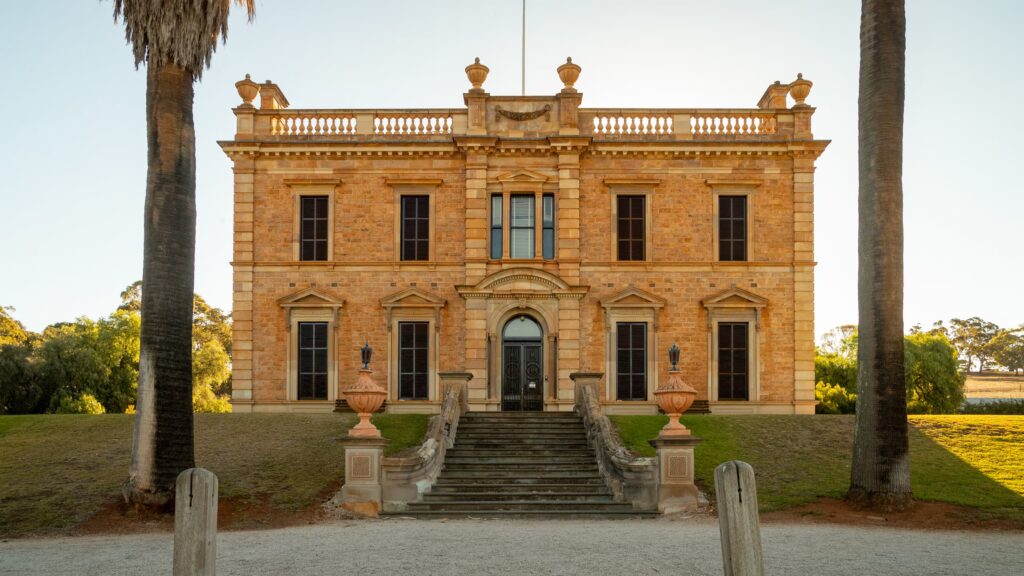
Martindale Hall is a rare jewel of Georgian architecture and colonial heritage.
Built in 1879–80 for pastoralist Edmund Bowman Jr., whose grandparents Mary and Thomas Bowman migrated from England to Tasmania in 1829 with their ten children and sheep, later settling in Pine Forest (now Enfield) South Australia.
Their eldest son Edmund established Martindale Station near Mintaro in 1839, creating a renowned merino sheep stud. After Edmund’s tragic death by drowning in the Wakefield River, his son Edmund Jr. inherited the estate. It was while studying law at Cambridge, that Edmund Jr. was inspired by the grandeur of English manors and resolved to build one of his own in South Australia.
Fifty English craftsmen travelled to shape the interiors with blackwood staircases, Italian marble fireplaces, and William Morris wallpapers. One of the most striking impressions when approaching the estate is the dramatic neo-Georgian façade rising from open fields.
The contrast between ornate architecture and the sparse landscape once led director Peter Weir, of Picnic at Hanging Rock, to describe it as “like an ocean liner beached, seemingly dropped out of the sky into the middle of the outback.”
Edmund married Annie Cowle in 1884 and they had six children, though only three lived at the Hall before financial pressures forced a sale in 1891. The Bowmans had fashioned the estate into a centre of rural leisure with polo fields, a cricket pitch, boating lake, and sweeping gardens.
Today, the only Bowman furnishing remaining is the immense billiard table in the library, positioned before the north wall was completed, where it still stands. William Tennant Mortlock purchased Martindale Station in 1891 for £33,000 as a wedding gift to his wife, Rosye. They had six children, but only two sons survived into adulthood: John Andrew Tennant Mortlock (“Jack”) and Frederick Ranson Mortlock.
The Mortlocks were hospitable and community-minded, hosting house parties and supporting local causes. Rosye aided St Peter’s Anglican Church in Mintaro, while her husband donated Mortlock Park to the community. They were regarded as generous employers and leading figures of the district’s colonial gentry.
Jack Mortlock, Martindale’s last private owner, was both pastoralist and philanthropist. With his mother, he made significant contributions to the Waite Agricultural Research Institute. After his brother’s death in 1936 and his mother’s in 1939, Jack arranged for his vast estate to pass to the State Library and University of Adelaide.
He married Dorothy Beech in 1948 and died in 1950, leaving an estate valued at £1,148,124. Dorothy remained at Martindale until 1965, when it passed to the University. His bequest of the Hall to the people of South Australia ensured its legacy.
Declared a State Heritage Place in 1980 and later a Conservation Park, Martindale Hall today remains a living testament to history. Its 32 rooms and seven cellar chambers offer a glimpse of colonial refinement. More than a mansion, it is an experience of beauty, heritage, and timeless grace.
Caretakers Mick & Sharon Morris can be contacted on 0417 838 897.
Stay connected: follow Martindale Hall on social media.

Leave a Reply